Cosmetic intelligence
Fortnite Skin Rarity
How Fortnite Skin Rarity Works: Shop Returns, Battle Passes & True Scarcity
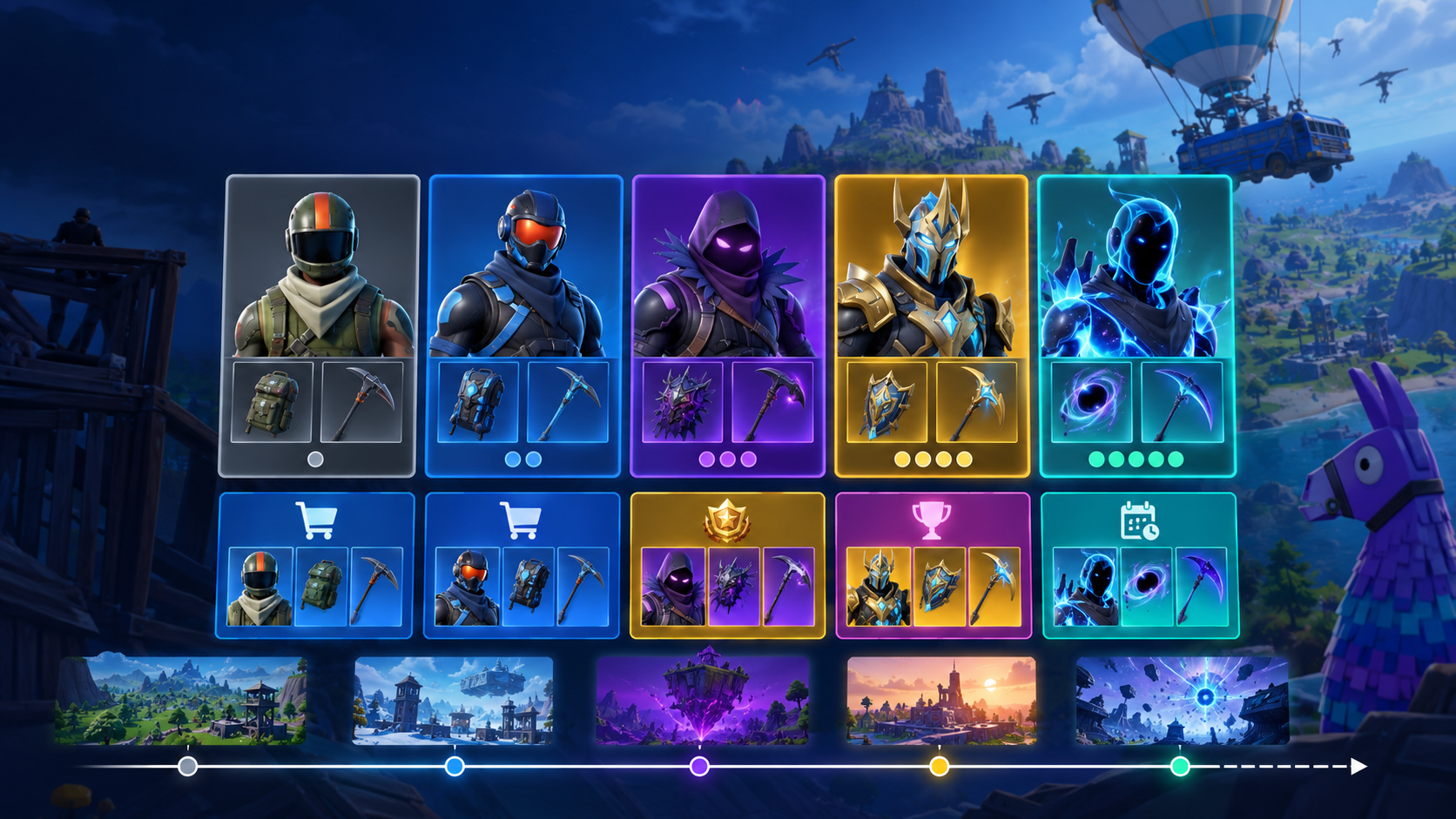
Direct answer
A Fortnite skin’s colour-coded rarity is only a classification. Its real availability depends on how it was obtained, whether it can return to the Item Shop, its release era and any event, Battle Pass, Crew or promotion rules. Check the cosmetic profile and live shop status before calling a skin rare.
Colour label
An in-game classification
Acquisition route
Shop, Battle Pass, event, Crew or promotion
Useful evidence
Profile facts and live availability
Return certainty
Decided only by Epic
In Fortnite, rare can mean a colour-coded game label or a cosmetic that players rarely encounter. Those are different ideas. The first describes an item category; the second is a judgment about availability, age and the route through which players could originally get it.
A useful rarity guide separates the signals instead of collapsing them into one badge. This avoids the common mistake of calling every Legendary Outfit hard to obtain while ignoring Battle Pass, event and promotion rules.
The four questions behind Fortnite skin rarity
| Stage | Check | Why it matters |
|---|---|---|
| Label | What classification is shown? | A descriptor, not a scarcity score |
| Route | How was it earned? | Sets the relevant availability rules |
| History | When was it released or seen? | Provides context |
| Live status | Is it currently in the shop? | Answers whether it can be bought now |
A label is only the first fact
A colour or rarity label can help identify a cosmetic and may reflect its original presentation in-game. It does not tell you ownership numbers, a future return date or whether a skin was locked to a specific season.
Compare Midas with Renegade Raider. Their player interest comes from different cosmetic histories, and no single colour can tell either complete story.
The acquisition route matters most
Ask how the Outfit entered Fortnite. Item Shop cosmetics belong in a rotation conversation, even though individual returns are unpredictable. Battle Pass rewards, events, Crew offers and promotions can have entirely different availability rules.
This is why FortRift profiles retain concrete fields: set, release information and price context where available. Then today’s Item Shop answers the separate question that history cannot: is it on sale right now?
Scarcity is not a promise or an investment signal
Players use rare to describe nostalgia and visibility in matches. That is fine as community language, but it is not proof of future value or permanent unavailability. Fortnite remains a live game and Epic can change availability decisions.
A reliable article says what is known, identifies the acquisition route and avoids invented certainty. If a cosmetic is absent today, it means it is absent today—not that a return has been scheduled.
Step-by-step guide
- 1
Open the cosmetic profile
Use the Fortnite skins archive to check classification, set and release data.
- 2
Identify the original route
Separate Item Shop cosmetics from Battle Pass, event, Crew and promotional rewards.
- 3
Read history in context
Compare cosmetics only with others that have a similar route to players.
- 4
Check the current shop
Use today’s Item Shop for a live availability check.
Common mistakes
Equating Legendary with scarce
A higher label does not establish future availability.
Ignoring the acquisition route
How a cosmetic was earned is usually more important than its colour.
Treating rarity as a price claim
FortRift documents cosmetics for players; it does not present them as an investment market.
Frequently asked questions
What is the rarest Fortnite skin?
There is no single official scarcity ranking. Acquisition route, age and availability rules matter more than a colour label.
Can Item Shop skins become rare?
They can be seen less often after an absence, but Epic controls future rotations.
Are Battle Pass skins rarer than Item Shop skins?
They use different availability paths. Read each cosmetic’s individual route before comparing them.